
In many FMCG markets across Europe, discounters have become or are heading to be the most powerful retail channel. Their rapid expansion is reshaping pricing, margins, innovation pipelines and brand strategies across the entire industry.
I remember a conversation with the CEO of a dairy company where private label represented 65% of total sales.
We were sitting in a conference room. Outside the window — a dairy plant running 18 hours a day. The company was in the middle of yet another difficult round of price negotiations with discounters.
And the CEO asked:
“Should we build our brand, or stay with private label? We have production lines, people, volume, and contracts… but our margins keep shrinking.”
It’s not an easy question.
It’s an existential one.
At another food company, during my presentation to the board, someone asked:
“Should we keep fighting for discounter listings? We need the volume, but it’s getting harder to sell to smaller stores — there are fewer and fewer of them.”
Over the past years, I’ve seen dozens of FMCG companies struggling with the exact same dilemma. Discounters now hold more than 40% of the Polish FMCG market — and they doubled their share in less than a decade. Most companies that failed to build a brand compensated with a wide assortment, price competition, and limited direct distribution.
The Polish Opportunity
The good news is that Polish discounters are evolving differently from those in Germany.
In Germany, simplicity and limited assortment dominate — typically 1,500 SKUs, minimal innovation, maximum efficiency.
In Poland, we’re seeing the “supermarketization” of discounters. Polish Lidl and Biedronka now stock 3,000+ SKUs. They test innovations. They give manufacturer brands shelf space. They run promotional campaigns similar to traditional supermarkets.
And that creates an opportunity — but only if you choose your strategy clearly.
Three Strategies, Three Different Futures
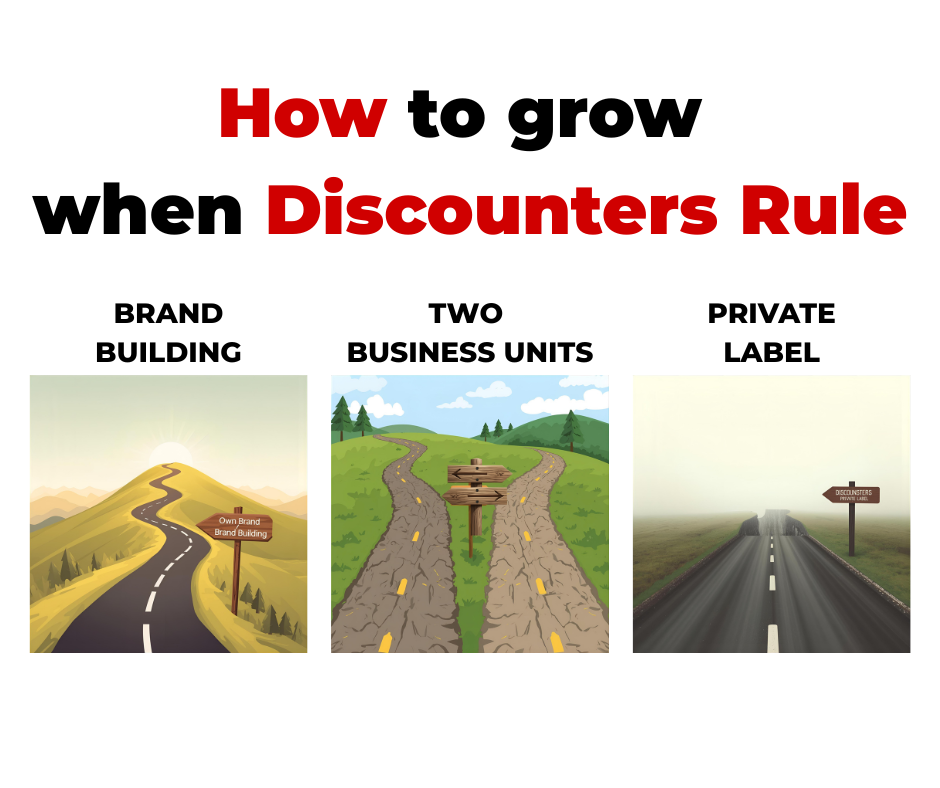
For companies wondering which direction to choose, there are really three strategies. Each represents a fundamentally different business model — with its own logic, risks, and long-term consequences.
STRATEGY A — Build the Brand
This means investing in consumer awareness, product innovation, premium positioning, and direct relationships with retailers — not as a private label supplier, but as a brand owner.
What it requires:
- Marketing investment (3-7% of revenue minimum)
- Strong marketing capabilities (with the marketing function represented at the Executive Board level)
- Innovation pipeline and NPD capabilities
- Sales team focused on brand sell-in, not just volume
- Higher gross margins to fund brand building (35-45% vs 15-25% in private label)
- Time — typically 5-10 years to build meaningful brand equity
What you get:
- Pricing power and margin protection
- Negotiating leverage with retailers
- Ability to expand into new channels (e-commerce, convenience, HoReCa)
- Asset value — brands can be sold, licensed, or scaled internationally
- Long-term independence
The risk: Failure. Brand building is hard. Most attempts fail. You invest millions and the brand doesn’t take off. But if you succeed, you own your destiny.
STRATEGY B — Produce for Discounters and Retail Chains (Private Label)
This means becoming an efficient contract manufacturer — optimizing production costs, securing long-term volume agreements, and accepting thin margins.
What it requires:
- Operational excellence and cost leadership
- High capacity utilization (85-95%)
- Long-term contracts with retailers (3-5 years)
- Continuous efficiency improvements
- Acceptance of 8-15% EBITDA margins
What you get:
- Stable, predictable volume
- Lower commercial costs (no marketing, minimal sales team)
- Clear focus on production efficiency
- Immediate revenue from day one
The risk: Existential dependence. One customer can represent 40-60% of your revenue. When they renegotiate terms or switch suppliers, you have no fallback. You own production capacity, but not your future. You’re a cost line in someone else’s P&L.
STRATEGY C — The Most Common Temptation
“Let’s build our brand but keep private label. Surely we can combine both.”
Yes — but only under one condition:
Two separate business units. Two P&Ls. Two teams. Two cost structures.
Without this separation, the volume–cost pressure from private label always wins. Your sales team focuses on quick private label deals. Your innovation pipeline gets starved. Your brand investment gets cut when quarterly results disappoint.
I’ve seen this play out dozens of times:
- The brand team proposes a premium innovation → management says it’s too expensive
- The private label customer demands lower prices → you cut costs across the entire company, including brand support
- Your best salespeople focus on volume deals with discounters → the brand gets leftover attention
Strategy C works only if:
- Branded business has its own GM with full P&L ownership
- Separate sales teams with different KPIs (brand: margin & distribution; private label: volume & efficiency)
- Different cost structures (brand products can have 20-30% higher COGS for better quality/innovation)
- Clear transfer pricing when private label uses brand production capacity
Without this, you end up with the worst of both worlds: brand investments that don’t deliver, and private label margins that keep shrinking.
What Does This Mean in Practice?
In the Polish FMCG market, choosing a strategy is not a matter of “let’s try this direction.”
It is a decision about who you want to be 10–20 years from now — and what level of risk you are willing to take.
Strategy A requires courage, market competencies, investment, and long-term consistency. It’s the hardest path — but the only one that gives you control over your future.
Strategy B brings fast volume and operational focus — but comes with existential dependency on customers who will constantly pressure your margins.
Strategy C works only if the two business models are structurally separated. Most companies lack the discipline to maintain this separation.
The Worst Strategy?
Trying to do A and B within one team, one process, and one P&L — while telling yourself you’re “keeping options open.”
This almost always ends in failure.
You end up with a weak brand that can’t command premium pricing, and a private label business that can’t compete on cost with pure contract manufacturers.
So Ask Yourself
Which business are you really in?
Because the discounters won’t wait for you to decide. They’re growing fast, consolidating power, and getting better at squeezing suppliers every quarter.
Your competitors are choosing their strategies right now.
The question is: will you choose yours consciously — or let the market choose for you?
