

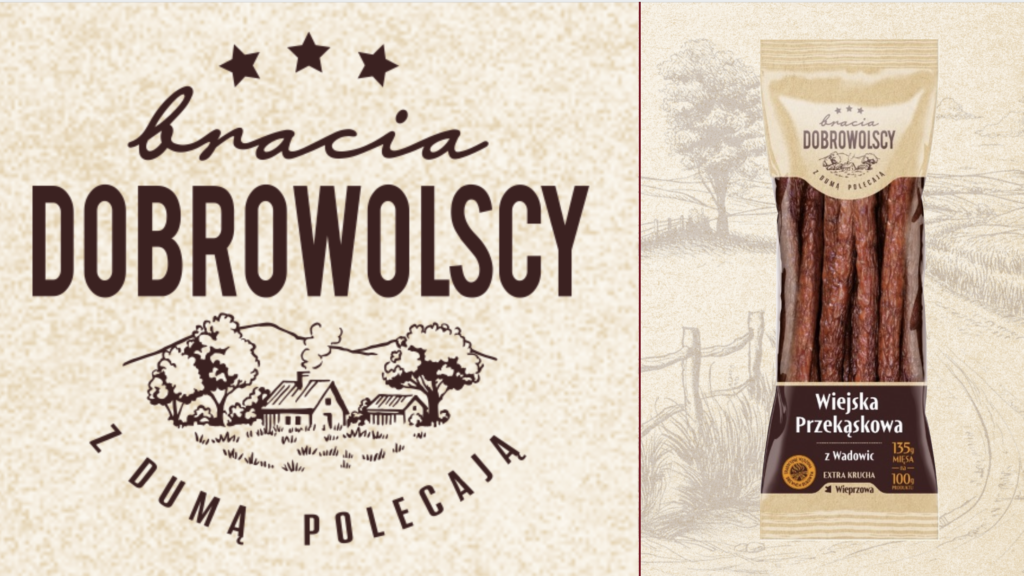
Launching a new brand is one of those moments when marketing and sales meet at a single point. It is a moment of excitement, but also the beginning of a new chapter—one that can shape the future of an entire category.
A brand launch is not only the culmination of months of work; it is also an opportunity to engage everyone who will be responsible for developing the brand in the years to come.
It is the moment that closes two key stages of marketing work:
- The development and validation of the brand concept and its products
- Commercialization—preparing all elements of the marketing mix that enable a successful market entry
For me personally, this launch is also the result of an intensive 18-month collaboration with the marketing team at Dobrowolscy. Working on a new brand and an innovative product reminded everyone involved that real marketing resembles an expedition into the unknown—it starts with questions and hypotheses and ends with concrete solutions that were often not even considered at the beginning.
The product Kiełbasa Wiejska Przekąskowa z Wadowic by the Bracia Dobrowolscy brand, which received the Pearl of the Market Award in 2025, did not come as a surprise to me. That said, I won’t hide the great satisfaction I feel seeing this recognition awarded to a company I have had the honor to work with since September 2023. While the product still has a long road ahead to achieve full market success, everything indicates that it is on the right path.
Why am I not surprised? Because this project followed a complete process that I refer to as the Marketing Growth Cycle, based on best practices developed over decades by successful FMCG corporations. In short, this process includes the following stages: analysis, concept, validation, business case, commercialization, marketing plan, launch, and monitoring.
Less than two years ago, this product existed only as an idea on paper. Where did it come from? On the one hand, from an analysis of consumer trends and the competitive landscape. On the other, from the search for a product idea rooted in a strong consumer insight—one that would not only differentiate the product, but also draw from the company’s heritage. One additional objective guided these efforts throughout: brand building.
After receiving the green light from the company’s Management Board, we began working with a two-person marketing team on prototypes. One stream focused on the product itself, the other on strategy and marketing communication. Based on the product positioning, a creative brief was developed, followed by multiple packaging concepts.
A critical stage of the project was the validation of both the strategy and its execution through consumer research. With the support of a research agency from Kraków, we conducted studies among consumers from the segments defined in the initial product and brand strategy. Despite significant differences in their profiles and places of residence, the research results were remarkably consistent—across product variants, brand logo, and packaging designs. We had a clear winner, along with valuable guidance on how to fine-tune both the strategy and the product’s marketing mix.
This was a particularly unique experience. Throughout my entire career, focus group discussions (FGDs) have rarely produced such consistent results—perhaps with the exception of the Harnaś brand—even among groups from the same segment. Observing the sessions from behind the one-way mirror, we could see spontaneous reactions and emotions accompanying the discussions, and already at that stage we knew there was a strong chance of success.
What is worth emphasizing here is how many Polish companies still skip consumer research when developing new products and their marketing strategies—despite the fact that the cost of such research is marginal compared to the total cost of product development and promotion. In some cases, it can even be lower than the cost of listing a product in a single retail promotional leaflet.
After several months of commercialization, the product was presented to the entire sales organization and later to key retail partners. The feedback was overwhelmingly positive, accompanied by growing distribution. The new product and brand began to exist in the awareness of buyers and store managers. This award, along with the first positive market results, confirms that such “mini-innovations” should be a core component of the marketing strategy of any company operating in saturated markets filled with similar products.
Now the company faces the second, equally important stage: reaching not only the minds, but also the stomachs of consumers. I keep my fingers crossed for perseverance—and I would like to thank the Dobrowolscy marketing team for the excellent collaboration.
#BrandLaunch #FMCG #MarketingStrategy #ProductLaunch #BrandManagement #ConsumerInsights
