

A growth strategy they don’t teach in marketing textbooks
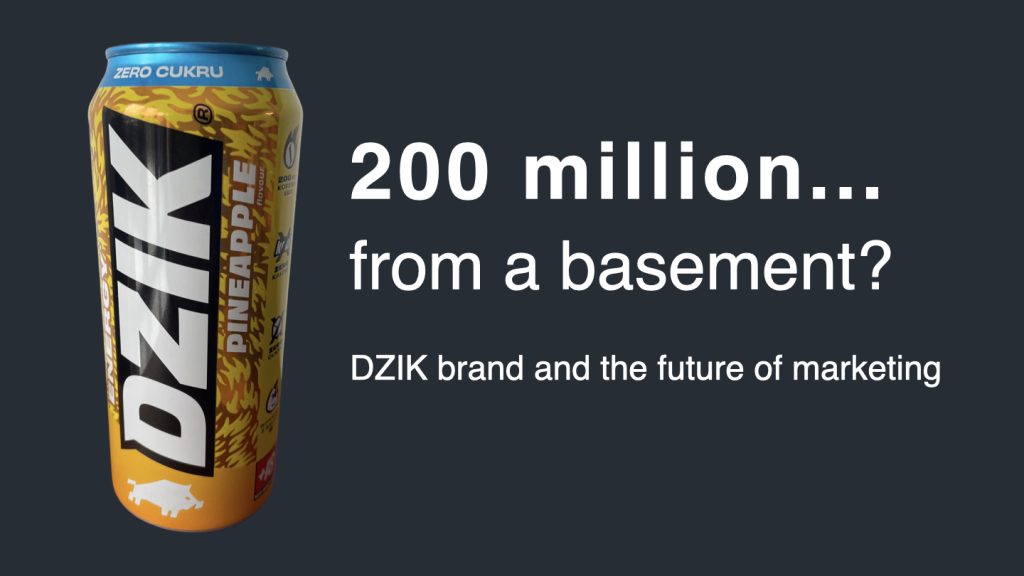
Most FMCG brands follow the same playbook:
product → advertising → distribution
DZIK did the opposite.
On a store shelf it looks like an ordinary product.
In reality, it represents one of the most interesting brand strategy case studies of recent years.
The story begins with the Polish brand DZIK — a company that demonstrates how a very different growth model can work in practice.
The sequence looks like this:
community first → product second → scale later
Results That Need an Explanation
The growth trajectory of the brand is striking.
2021 — 23 million PLN
2022 — 50 million PLN
2023 — 113 million PLN
2024 — over 200 million PLN (45 million EUR)
In just four years the company increased its revenue almost tenfold.
Even more interesting is the sales structure.
Around 50% of the company’s revenue comes from online channels, while in most European FMCG markets e-commerce typically represents less than 10% of category sales.
This tells us one thing:
The company operates according to a very different model than traditional consumer brands.
The Origin: Community Before Product
The origins of the brand go back to 2007, when four teenagers built a small gym in a basement and started publishing training content online.
The most important strategic fact is this:
The brand’s first product was not a physical product.
It was knowledge — free and accessible to everyone.
Before any product appeared:
there were no sales
no distribution
no marketing budget
There was only content and community.
The products came later — in response to the audience.
The Reversed Marketing Model
Most companies operate according to a familiar sequence:
product → marketing → sales → community
The DZIK model looks very different:
community → trust → product → sales
This is a fundamental strategic difference.
The brand does not need to fight for the customer’s attention.
The customer already knows the brand.
Why Competitors Cannot Copy This Model
Large companies can copy many things:
- packaging
- product ingredients
- pricing
- distribution
But they cannot copy a relationship with a community.
Relationships are built over years and depend on:
- authenticity
- consistency
- credibility of the founders
- long-term trust
This is a competitive advantage that cannot be bought with media budgets.
The Strategic Insight
A brand built around a community does not compete primarily with product features.
It competes with identity.
Customers do not simply buy the product.
They buy confirmation of who they are — or who they want to become.
This changes everything.
| Traditional brand | Community brand |
| sells product features | sells identity |
| talks about the product | talks about lifestyle |
| builds awareness | builds belonging |
The Role of the Product in This Model
In a community-driven brand the product is not the beginning of the relationship.
It is a natural extension of it.
That is why in a community-first model:
- there is no need for a massive launch campaign
- there is no need to educate the market
- there is no need to explain the value proposition
The market already understands the brand.
What Companies Can Apply
Not every brand can become a community brand.
But every company can apply elements of this model.
Three principles that work in almost every industry
1. Knowledge builds stronger loyalty than price promotions
Educational content builds trust faster than advertising.
2. Community reduces customer acquisition costs
People recommend brands they identify with.
3. Authenticity increases conversionThe more a brand behaves like a real person, the more trust it earns
Why This Is the Future of Marketing
Today’s consumers:
- ignore advertising
- do not trust sales messages
- compare prices within seconds
This means the advantage increasingly belongs to brands that:
- build relationships instead of campaigns
- create content instead of ads
- invest in trust instead of reach
The Strategic Lesson from This Case
The most valuable brands of the future will not emerge primarily from marketing departments.
They will emerge around people, ideas, and communities
🎥 Watch the full video analysis
https://www.youtube.com/watch?v=79f9HfDT99c
📘 Want more insights like this?
Subscribe to receive new analyses of brand strategy, marketing and product growth.
