Not every new product is an innovation – and not every innovation is the same.
Some create global markets, others merely damage the category and erode consumer trust.That is why I developed a practical framework – the Product Value Pyramid.
It is a tool that helps marketers and CEOs better understand the true market potential of new products and the value they offer to consumers.
What is the Product Value Pyramid?
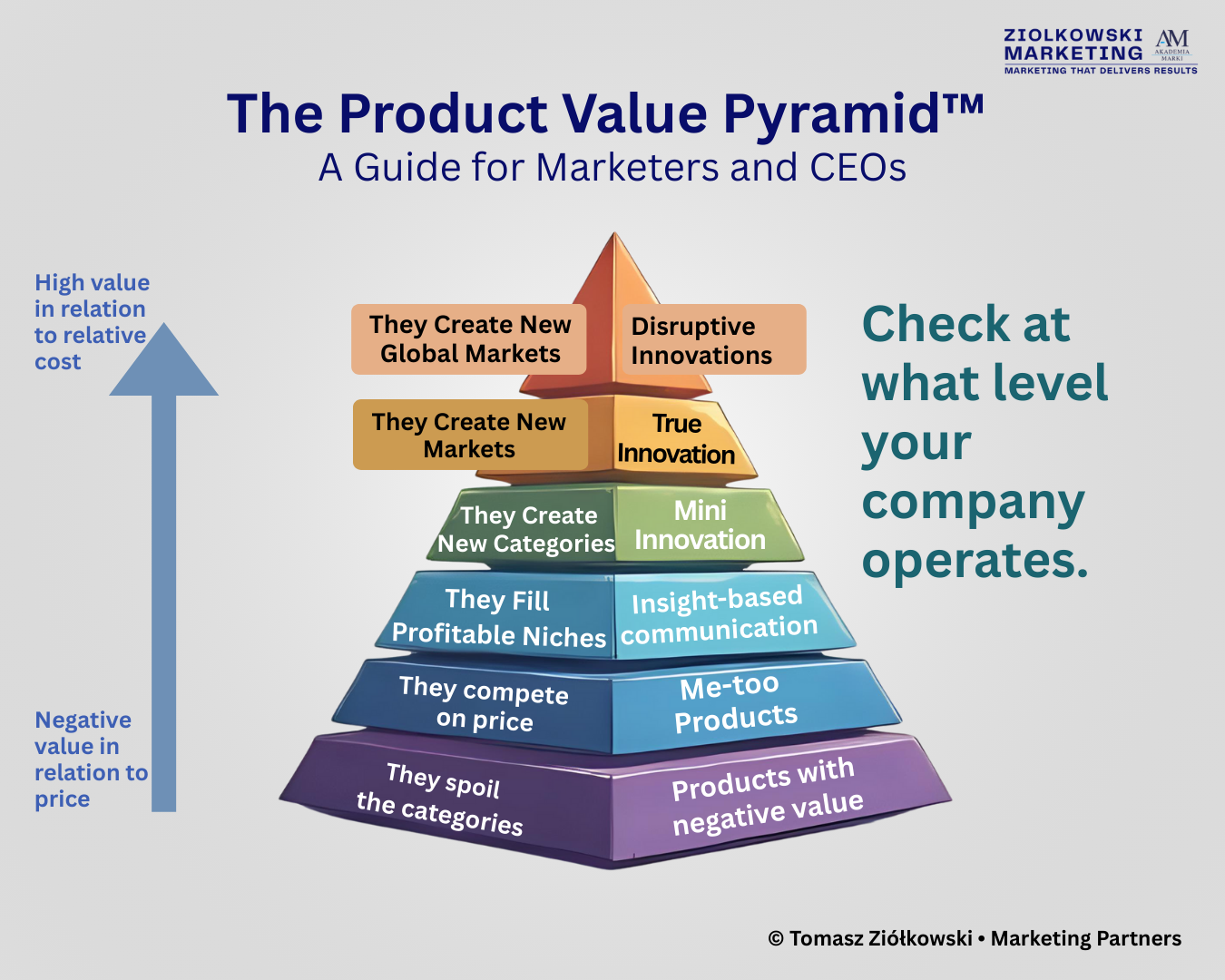
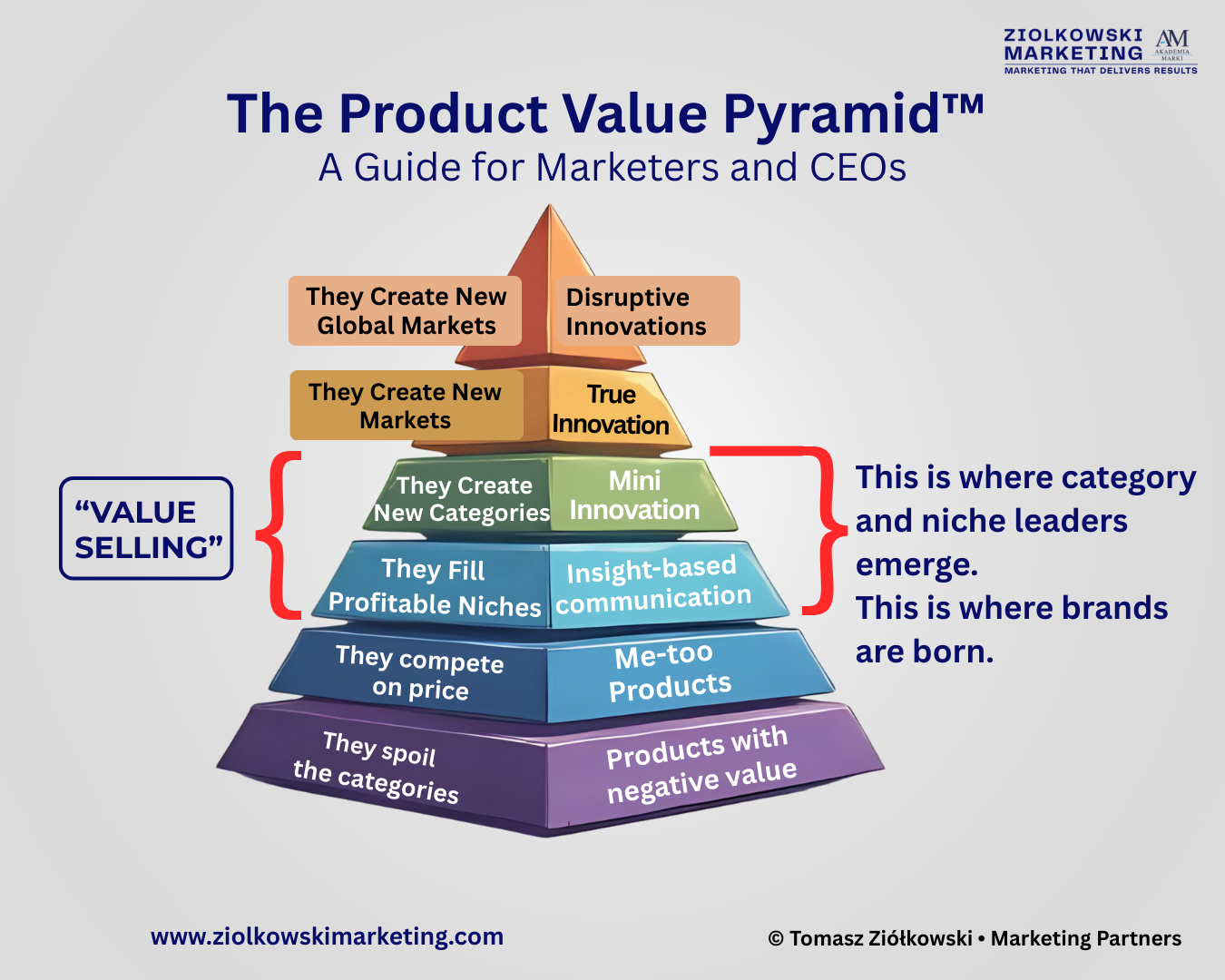
The Pyramid shows six distinct levels of value on which new products may operate – from breakthrough innovations that create entirely new markets to negative-value products that spoil entire categories.
👉 The Pyramid is a concept that will help you ask strategic questions in such areas as:
- At what level of innovation is your company currently operating?
- Is your portfolio truly creating value or just copying competitors?
- Are your marketing activities outcome-oriented or merely activity-driven?
Six levels of product value
Disruptive Innovation
Transformational products that create global markets and change the rules of the game.
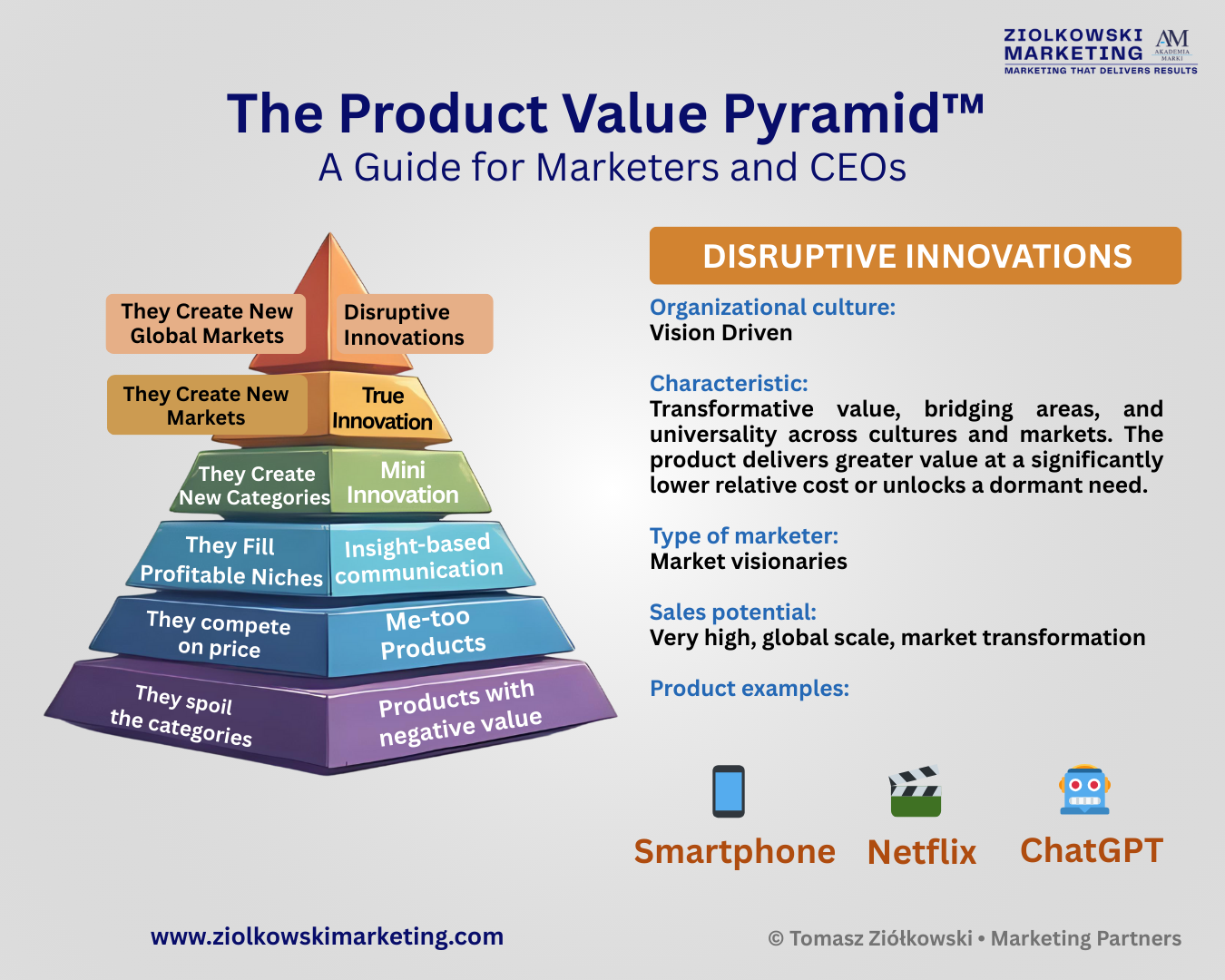
- Organizational culture:
“Vision-driven”. The whole company and all resources are aligned behind delivering a breakthrough. - Characteristics:
Products or services that provide a synergy of benefits at a significantly lower relative cost – e.g. the smartphone combines the value of a phone, messenger, TV, and computer in one mobile device. The true value lies in mobility and instant access to all functions. - Risks:
Very high – due to high development costs and the challenge of verifying consumer value until a working prototype exists. - Marketer type:
Market visionaries – people with both vision and the right timing and environment to realize it. - Business potential if successful:
Extremely high, global scale. These products become the foundation of strong global brands. - Examples:
iPhone, Netflix, ChatGPT, Ryanair.
True Innovation
Products based on new technologies or scientific breakthroughs that deliver a unique, hard-to-copy benefits
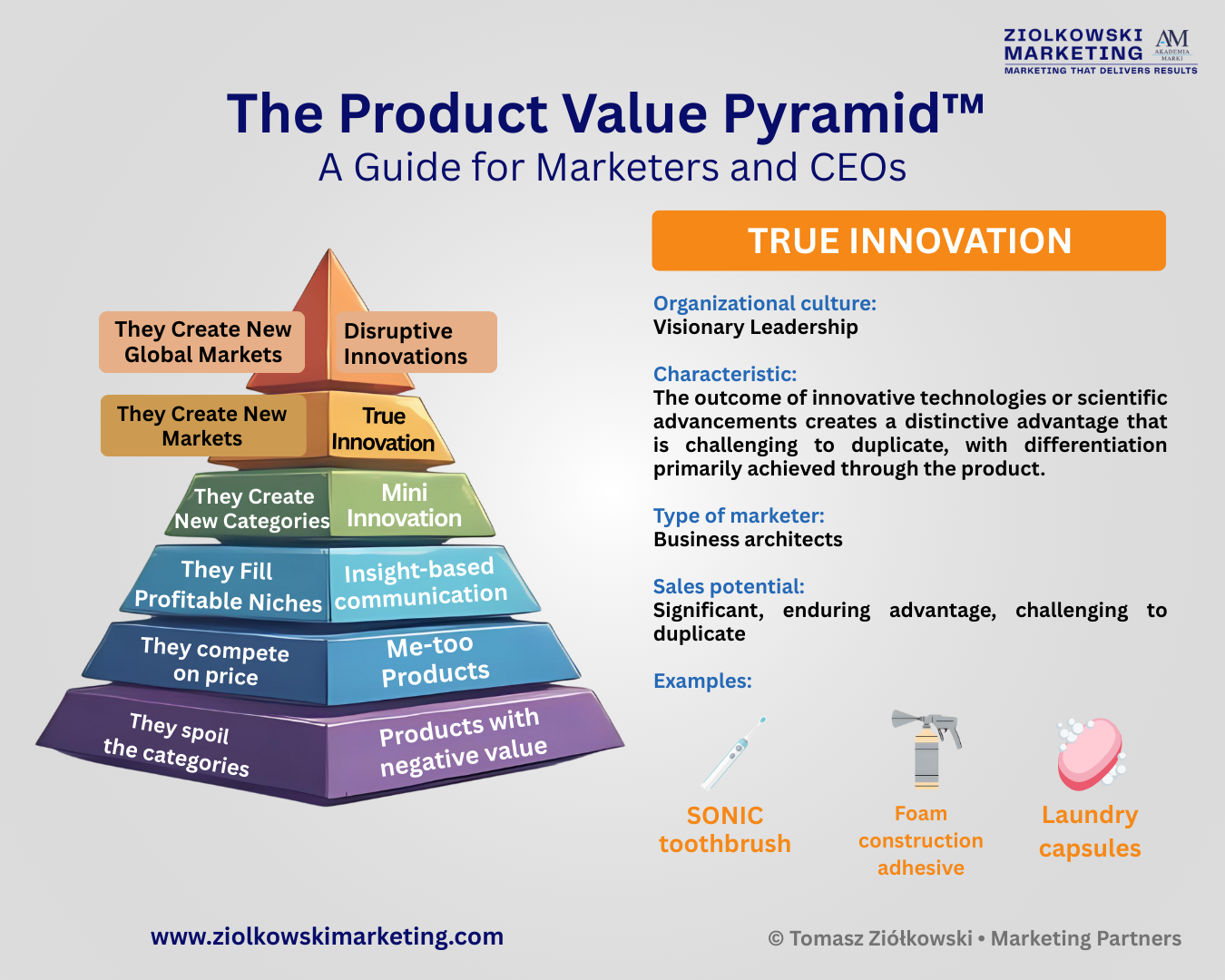
- Organizational culture:
“Vision-driven”. A significant part of resources is dedicated to bringing the innovation to market. - Characteristics:
Solutions built on technology competitors cannot quickly replicate – e.g. sonic toothbrushes using sound waves, or laundry capsules combining multiple agents in one convenient format. - Risks:
High R&D and patent costs, plus uncertainty until a functional prototype exists. - Marketer type:
Business architects – visionaries with a focus on solving specific problems, often outside marketing departments but with strong communication and sales skills. - Business potential:
High – long-lasting competitive advantage if well promoted as “the first of its kind”. - Examples:
Sonic toothbrush, laundry capsules, polyurethane foam adhesives.
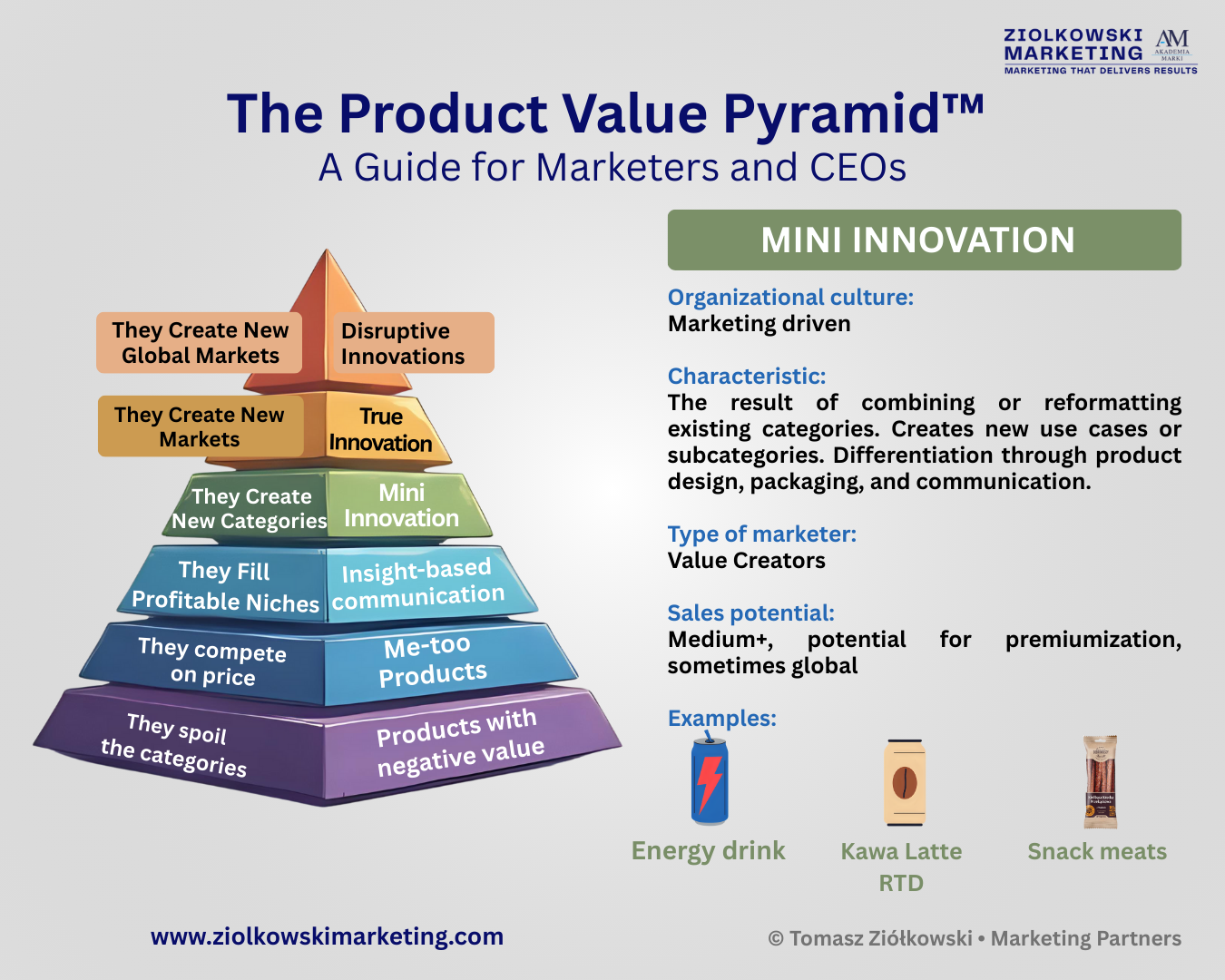
Mini Innovation
Products that recombine or reformat existing categories to create new benefits or usage occasions.
- Organizational culture:
“Marketing-driven”. Marketing plays a strategic role, with strong teams, training, and budgets often above 5% of net sales. - Characteristics:
Built around consumer trends, combining two categories or introducing a new format. Famous examples include Red Bull (coffee’s energy benefit + soft drink format) or snacking sausages (traditional cold cuts in an “on-the-go” pack). - Risks:
Moderate – mainly adaptation of production lines and advertising investments. Consumer testing usually provides reliable feedback. - Marketer type:
Value creators – scanning trends and adjacent markets to generate synergistic product ideas. - Business potential:
Medium to high – with premiumization and global scaling if packaged and promoted well. - Examples:
Red Bull, RTD latte coffee, snacking sausages, fruit pouches for kids.
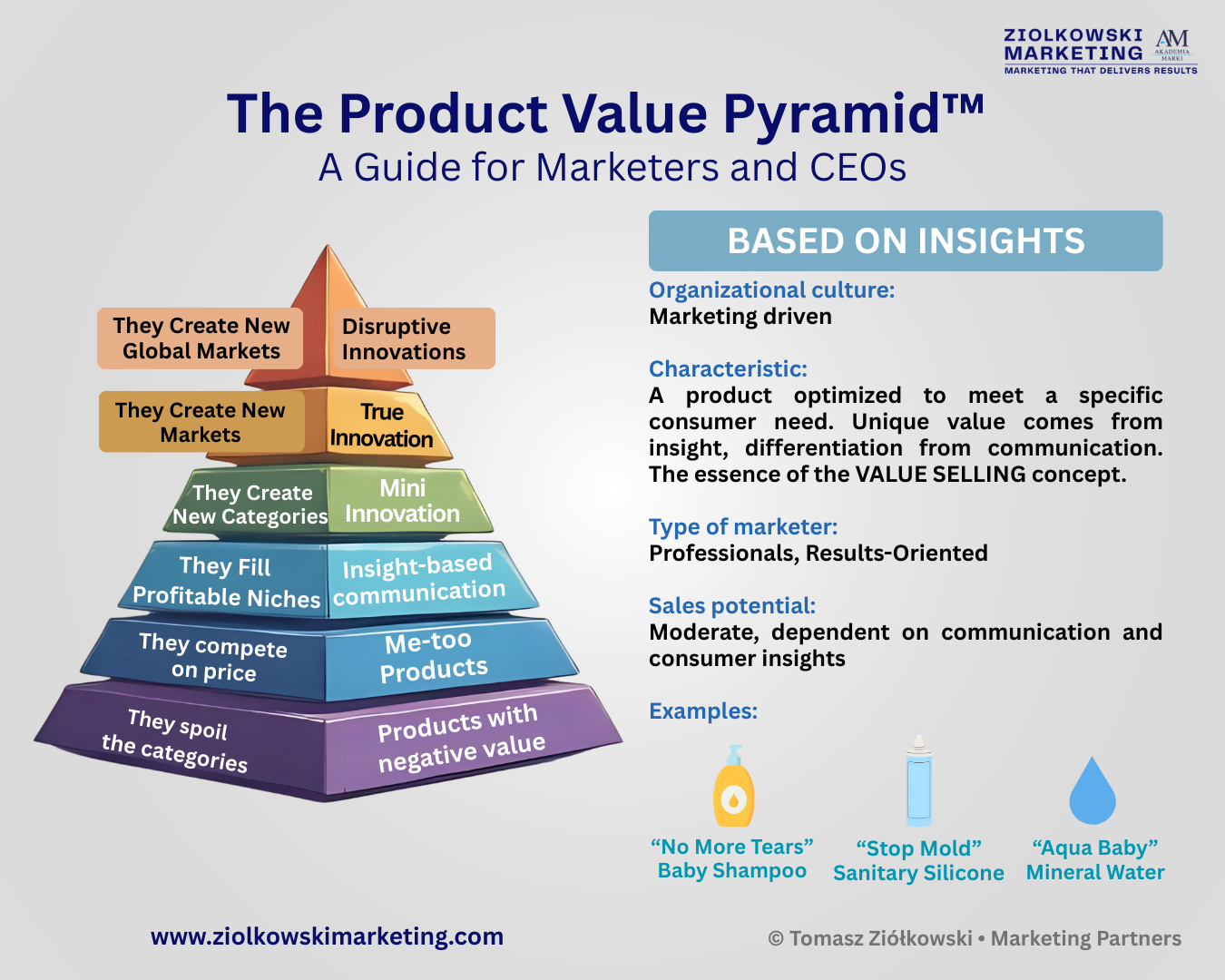
Insight-based Innovations
Products whose advantage comes not from technology itself but from accurately reading consumer needs and translating them into benefits. Products are similar to the ones that are offered already on the market.
- Organizational culture:
“Marketing-driven”. Marketing plays a strategic role, with board-level representation, highly skilled marketers, continuous competence development, and consumer marketing budgets often exceeding 5% of net sales. - Characteristics:
The product may be technologically simple, but it stands out thanks to the insight – e.g. “No More Tears” shampoo addressing parents’ fear of eye irritation, “Stop Mold” silicone tackling health and aesthetic issues in bathrooms, or “Aqua Baby” mineral water reassuring parents about healthy hydration for infants. - Risks:
Strong dependence on communication – if the insight is not conveyed clearly, the product will fail to gain advantage. - Marketer type: Marketing craftsmen – masters of communication who can extract one strong benefit and turn it into a compelling message. They spot niches and consumption opportunities others overlook.
- Business potential:
Moderate – success depends on consistent awareness building and credibility. - Examples:
“No More Tears” shampoo, “Stop Mold” silicone, “Aqua Baby” mineral water.
Me-too Products
Products that replicate existing solutions with little differentiation in communication.
- Organizational culture:
“Product-driven”. Operations and sales dominate, with little external market or consumer focus. The belief is that the product alone determines success, not how it is marketed. Marketing plays an executor role, mostly limited to commercialization of new products and trade marketing. Budgets rarely exceed 2% of net sales. - Characteristics:
Often just a new flavor or scent – cosmetic changes rather than true value. Such products allow brands to “be present” but rarely build advantage. - Risks:
Competition is mainly price-based, leading to margin erosion and weak loyalty. - Marketer type:
Imitators – focused on reacting quickly to competitors rather than following their own vision. - Business potential:
Low – may deliver volume but at the cost of profitability. - Examples:
another beer flavor, yet another anti-wrinkle cream.
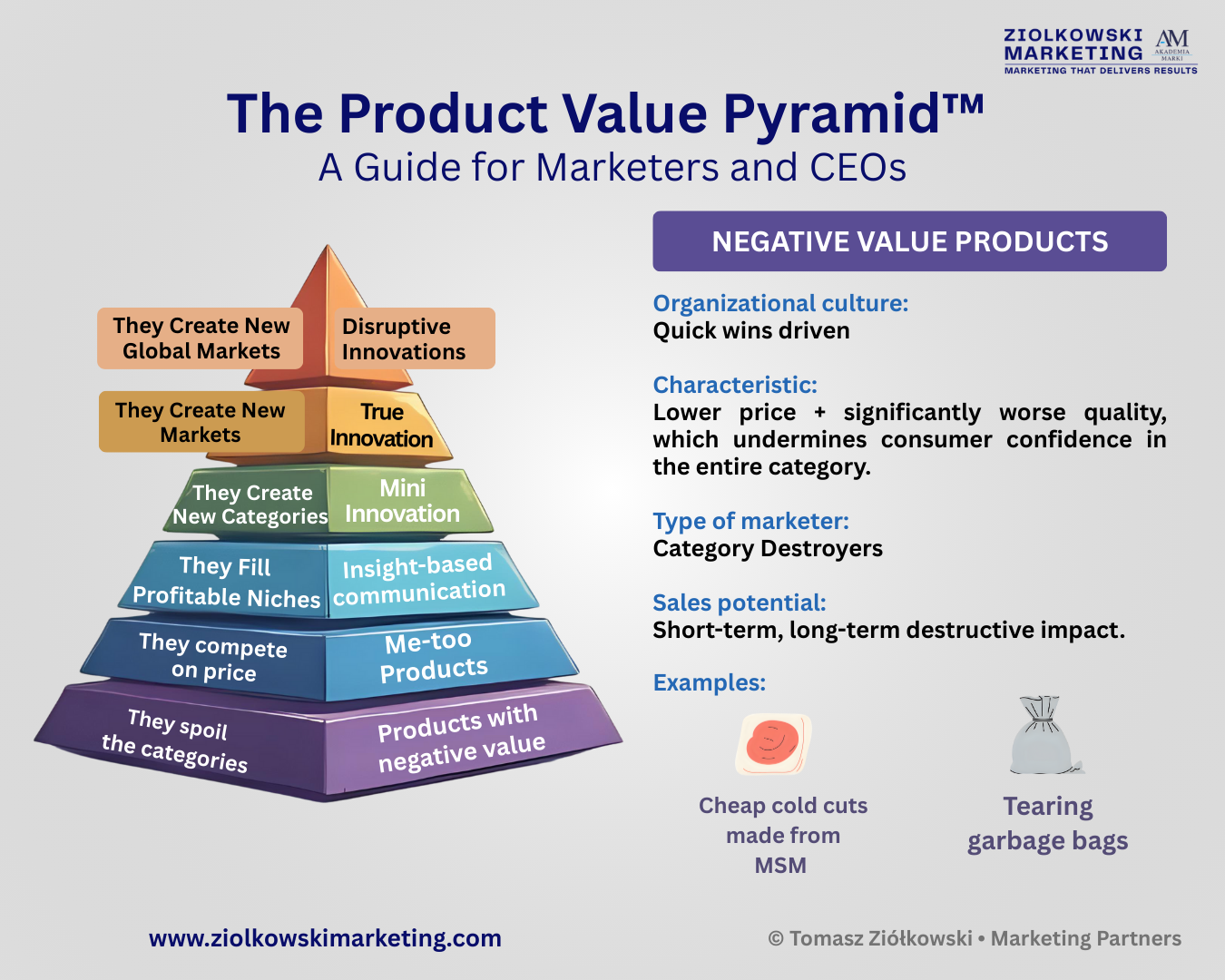
Negative Value Products
Products that reduce quality standards and damage consumer trust in the entire category.
- Organizational culture:
“Quick-results-driven”. Management believes low price, not quality, drives success – or simply avoids long-term investments that carry risk. The focus is on short-term profit. - Characteristics:
Products of significantly lower quality, offered at lower price – e.g. mechanically separated meat sausages or thin garbage bags. Consumers quickly experience disappointment and lose trust not only in the brand but in the whole category. - Risks:
Minimal short-term for the producer, but enormous long-term for the category. These products “poison” the market and reduce value for all players. - Marketer type:
Category destroyers – focused only on short-term sales. - Business potential:
Short-lived – quick sales at the expense of quality, no lasting loyalty. - Examples:
cheap sausages made with mechanically separated meat (MSM), thin garbage bags.
How to use the Pyramid in practice
The Product Value Pyramid is not just a theoretical framework – it is a practical tool you can apply in everyday business:
- Portfolio analysis: Identify how many of your products truly stand out versus how many simply copy competitors. Assess whether your portfolio offers meaningful internal differentiation.
- Communication review: Check whether your marketing focuses on product features or highlights one strong benefit that gives consumers a clear reason to buy.
- Brand analysis: Evaluate where your brands rank in spontaneous awareness. If they are not in the top three, it means your products must deliver stronger consumer value.
- Marketing budget: Verify what share of net sales is allocated to consumer marketing.
- People: Clarify the scope of responsibility within your marketing team – does it end with launching new products, or extend to delivering financial sales results? Audit team skills and identify where capabilities need to be strengthened.
Conclusion
Not every novelty is an innovation.
Some products create global markets, others fill niches, and still others erode trust in entire categories.
👉 The Product Value Pyramid is a compass for marketers and CEOs – helping assess new product strategies and ask the tough questions about the real value being offered.
About the Author
Tomasz Ziółkowski
Over 30 years of experience in international marketing and product management – first as a manager in multinational corporations (Carlsberg, Tchibo, Leaf/Cloetta, Reckitt Benckiser, Selena Group), and today as an independent consultant and trainer. He has led strategic marketing projects for both large and small companies across Poland, Europe, Asia, the USA, and Brazil.