
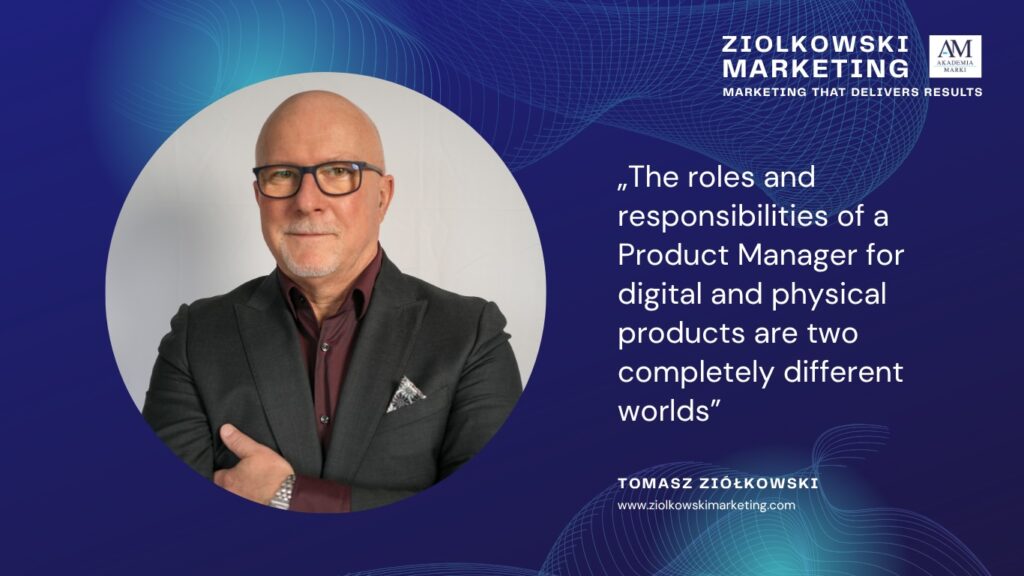
Does the role of a product manager look the same in an IT company and an FMCG company? It’s only seemingly the same. Even though the title may sound identical, the scope of responsibilities, required competencies, and work environments are often vastly different.
In this article, I highlight the most important differences between managing digital and physical products.
What Determines the Product Manager’s Role?
The scope of a product manager’s responsibilities depends on many factors: company size, business model (B2C vs. B2B), brand maturity, and the existence of a product marketing function. However, the key distinction is whether the product is digital or physical.
The rapid development of AI and digital technologies has led to most available courses and publications focusing on the digital product management environment. That’s natural – experts working on apps or SaaS platforms are more likely to share knowledge online and promote their content through social media.
Meanwhile, in the world of “analog” products – from cosmetics to construction chemicals – product management looks very different.
How Does Managing a Digital Product Differ from a Physical One?
1. Sales Channels – Digital vs. Retail
Digital products are sold almost exclusively online – via websites, app stores, or SaaS subscriptions.
For physical products (e.g., FMCG, home appliances, consumer electronics, construction chemicals), the main sales channels are still wholesalers and brick-and-mortar retail.
Example:
In Poland, online sales in the FMCG category accounted for only 3–4% in 2023; globally – around 5–7%. By comparison, in consumer electronics, online sales exceed 30%.
2. Sources of New Product Ideas
- Digital products often emerge as a direct response to a specific user need (insight), with the idea typically coming from the startup founder or product team leader.
- Physical products are usually developed based on market analysis, consumer research, and competitive benchmarking. Here, the PM acts more as an executor and validator of ideas rather than their originator.
3. NPD Process – Team Diversity and Challenges
In digital, New Product Development (NPD) teams tend to be homogeneous – developers, UX/UI designers, product owners.
In FMCG and non-digital sectors, product development involves highly diverse teams: technologists, engineers, procurement, marketing, sales, production – as well as external agencies and packaging suppliers.
➡️ The product manager’s role resembles that of a cross-functional project leader, with high responsibility and coordination demands.
4. Commercialization – Investment, Prototypes, Packaging
In the physical product world:
- Commercialization often requires investment in machinery, production lines, and packaging prototypes.
- Packaging serves a communication function, constrained by limited physical space.
For digital products:
- Introducing a new feature or version can be fast and relatively inexpensive.
- Marketing communication is virtually unlimited in space (websites, landing pages, content marketing).
5. Promotion and Marketing – Channels and Effect Measurement
- Digital products are promoted exclusively online: Google, social media, performance marketing, growth hacking.
Testing campaign variants and precisely measuring results (CTR, CPC, CAC, ROI) are standard practice. - Physical products are promoted through multiple channels: ATL, BTL, POS, digital, and trade marketing.
Measuring effectiveness requires tracking studies (e.g., brand awareness, usage & attitude) and sales/distribution reports.
6. The PM’s Role – Specialist vs. Process Leader
- In digital, the PM often runs tests, analyzes data, and co-decides on communication strategies.
- In physical products, the PM acts as a process manager – briefing agencies, analyzing results, assessing ideas, and coordinating teams.
Key competencies here include the ability to craft clear marketing briefs and interpret data from research and market reports.
7. Sales and Availability Impact
For physical products, success is heavily dependent on the sales team’s efforts – availability in stores, visibility, in-store promotions.
Therefore, the PM must be able to analyze sales and distribution data to identify barriers to growth.
Conclusion
A product manager of digital products and one of physical products may have the same job title, but their roles are fundamentally different. Each requires distinct skills, tools, work environments, and performance metrics.
If you manage a digital product – you have more control, faster feedback, and the ability to continuously optimize.
If you manage a physical product – you must be a great coordinator, analyst, and strategist operating in a far more complex ecosystem.
📩 Sign up for the newsletter or check out my courses:
👉 Explore online courses in practical marketing
👉 Subscribe to get the latest articles